Data Cleaning and Feature Engineering (Deep)
Build leakage-safe data pipelines and features that behave the same way in training and production.
Why This Matters
Feature quality is the highest-leverage part of practical ML. Most model failures are data failures wearing a model-shaped mask.
To become hire-ready at top companies, you need to prove you can design and maintain feature pipelines that are stable, testable, and leakage-safe.
Prerequisites
- Basic pandas/SQL transformation experience
- Familiarity with train/validation/test split logic
- Comfort with reproducible script-based workflows
Learning Outcomes
You will learn to:
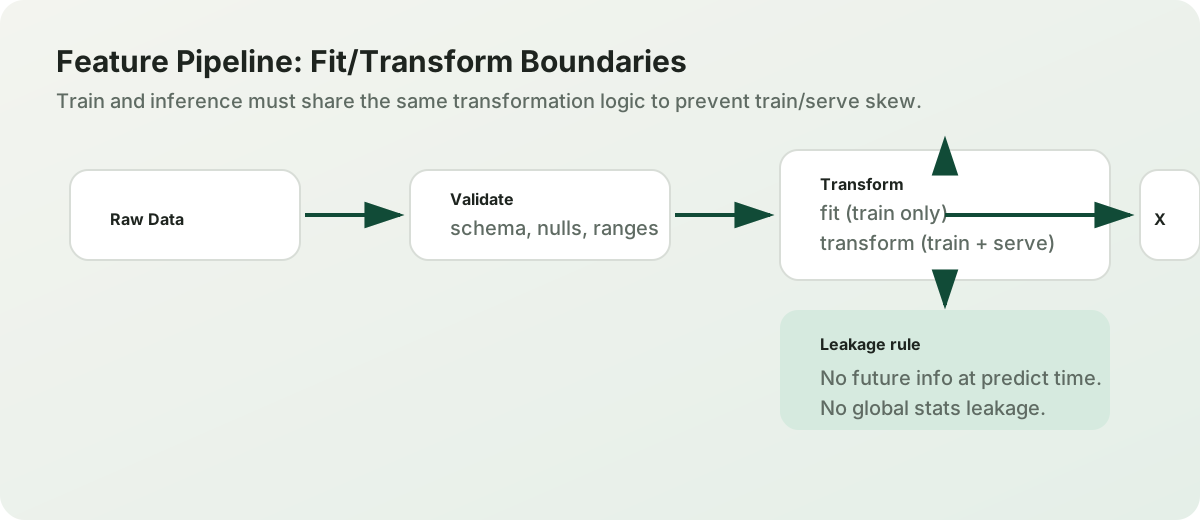
- Design feature pipelines with clear fit/transform boundaries
- Detect and prevent leakage (temporal, target, and cross-entity)
- Build feature quality checks for production reliability
- Evaluate feature stability over time and cohorts
- Make feature tradeoff decisions balancing signal vs operational cost
Core Concepts
1) Data Quality Dimensions
- Completeness
- Freshness
- Validity
- Consistency
- Uniqueness
2) Leakage Types
- Temporal leakage
- Target leakage
- Duplicate/near-duplicate leakage
- Leakage through global statistics
3) Feature Lifecycle
- Candidate generation
- Validation
- Selection
- Monitoring
- Deprecation
4) Train-Serve Consistency
- Shared transformation pipeline
- Versioned feature definitions
- Input schema contracts
Mental Models and Tradeoffs
Mental Model: "Features are product assumptions encoded in data"
Every engineered feature expresses a hypothesis about user/system behavior. Bad hypotheses create fragile models.
Mental Model: "Leakage is fake intelligence"
If a feature leaks future or label information, your model learns impossible shortcuts. It will fail in production where those shortcuts do not exist.
Tradeoffs
- Rich feature sets vs operational complexity
- Aggregation depth vs latency budget
- Feature interpretability vs predictive power
- Fast iteration vs strict quality governance
Details
A) Leakage detection framework
Use a checklist per feature:
- Is any information unavailable at prediction time?
- Is aggregation window aligned to event timestamp?
- Is target-derived proxy hiding in transformation?
B) Temporal feature engineering
Prefer event-time aware windows:
- rolling 7-day counts
- exponential decay signals
- recency-based transforms
C) Categorical encoding strategy
- One-hot for low-cardinality
- Frequency/target encoding with strict leakage controls
- Embeddings for high-cardinality contexts
D) Stability analysis
Measure PSI / distribution shift by cohort and time bucket. Remove or gate features that show unstable behavior with high business risk.
Implementation Walkthrough
- Define feature specification file (
feature_spec.yaml) - Implement pipeline stages: clean -> validate -> transform -> persist
- Add temporal split-safe fitting behavior
- Run leakage tests and fail pipeline on violations
- Produce feature report (missingness, drift, cardinality)
- Integrate selected features into training config
Common Failure Modes
- Fitting scalers/imputers on full dataset
- Using future events in feature windows
- Exploding cardinality without backpressure controls
- Silent null patterns after upstream schema changes
- Feature definitions undocumented and unowned
Interview Depth
Expect questions like:
- How did you detect and fix leakage in your project?
- Why did you remove a highly predictive feature?
- How do you monitor feature drift post-deployment?
- How do you balance feature richness against serving latency?
Hands-On Lab
Lab Task
Create feature-pipeline-lab with:
- Feature spec and owner metadata
- Leakage test suite
- Drift report over at least 2 time slices
- Train/serve parity validation
Required Deliverables
- Feature quality report
- Leakage test outputs
- Decision log for feature inclusion/exclusion
- Drift mitigation plan for top unstable features
Milestone Checklist
- Feature pipeline is reproducible and test-covered
- Leakage checks catch known bad patterns
- Drift report is generated automatically
- Selected features have clear rationale and ownership
- Train/serve feature parity is validated
Next Step in the Path
Use these robust features to run rigorous experiments in Supervised Learning End-to-End (Deep).
Diagram
Code Snippets
Leakage-safe fit/transform boundary
pythonclass Preprocessor: def __init__(self): self.mean_ = None def fit(self, X_train): self.mean_ = X_train.mean(axis=0) return self def transform(self, X): assert self.mean_ is not None return X - self.mean_
Temporal split reminder
textIf predicting at time T, features must be computed using data <= T.
Focus questions:
- Which transformations must be fit only on training data?
- How do you enforce this rule in tests?
- What drift signals would you monitor for top 3 features?
Continue Deeper
Leakage-Proof Feature Pipelines
Turn feature engineering from a notebook habit into a disciplined contract with train/serve parity and leakage defenses.
Stay in the loop
Get new ML/AI lessons in your inbox.
No account needed. We will send curriculum updates, launch notes, and practical learning resources.
Related Posts
More postsModel Selection Guide: When to Use Which ML Algorithm
A practical decision framework for choosing the right machine learning algorithm - from linear models to gradient boosting to neural networks - based on your data, constraints, and goals.
Evaluation Metrics Guide: Which Metric to Use and When
Accuracy is rarely the right metric. This guide explains every major ML evaluation metric - classification, regression, ranking, and generation - with clear guidance on when to use each one.
Python ML Quick Reference
The NumPy, Pandas, and scikit-learn one-liners you reach for every day - organized by task so you spend less time searching and more time building.