Python for ML Workflow (Deep)
Build a production-grade ML project workflow with reproducibility, experiment lineage, and deployment-ready structure.
Why This Matters
Most ML portfolios fail in hiring loops because they are not reproducible, not maintainable, and not production-oriented. A strong ML engineer is not just a model trainer; they are a system builder.
This post teaches you how to construct a workflow where another engineer can clone your repo, run one command, and reproduce your results with confidence.
Prerequisites
- Basic Python, virtual environments, and CLI usage
- Familiarity with Git and repository structure
- Intro knowledge of ML training scripts
Learning Outcomes
After this module, check that you can:
- Design a clean ML project architecture with clear boundaries
- Enforce reproducibility with dependency and config discipline
- Track experiments and artifacts for auditable decisions
- Separate exploration code from production pipelines
- Build training/inference interfaces safe for deployment handoff
Core Concepts
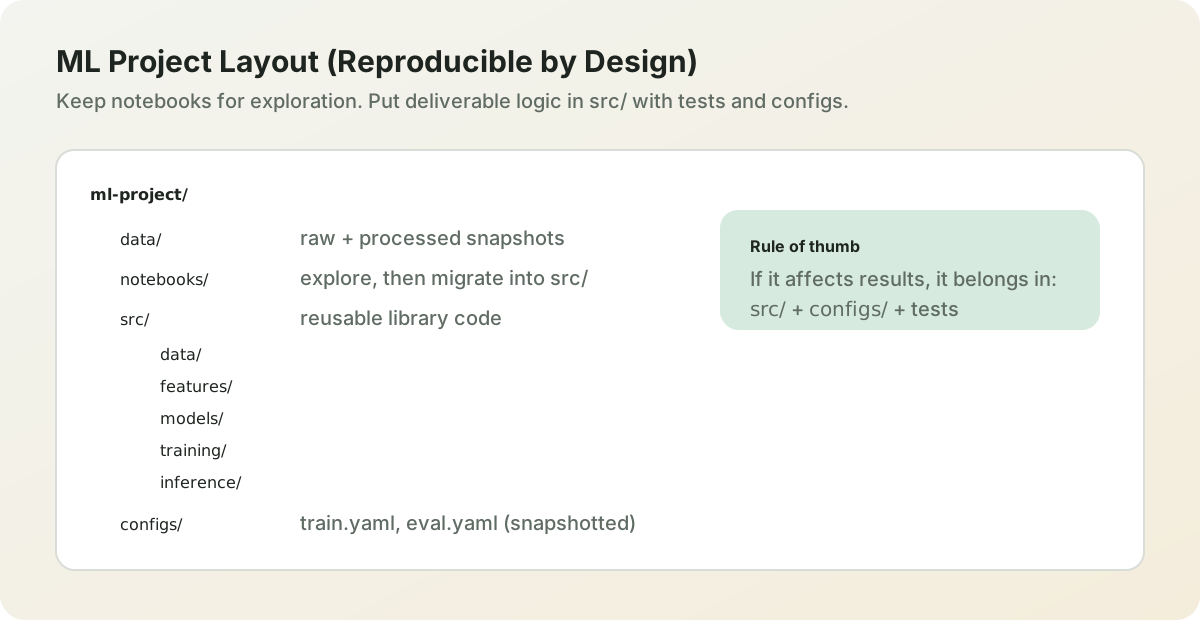
1) Project Architecture
src/for reusable codenotebooks/for exploration, not production logicconfigs/for parameterized runstests/for data and feature correctness checks
2) Reproducibility
- Pinned dependencies
- Deterministic seeds
- Immutable data/version references
- Config snapshots for each run
3) Experiment Lineage
- Track code hash, data snapshot, config, metrics, artifacts
- Keep promotion decisions linked to experiment evidence
4) Training/Inference Contract
- Explicit input schema
- Stable preprocessing pipeline
- Versioned model artifact
- Clear runtime assumptions
Mental Models and Tradeoffs
Mental Model: "Notebooks discover; modules deliver"
Notebook insights should move into tested modules quickly. If a pipeline depends on notebook state, it is a deployment risk.
Mental Model: "Every run is an audit event"
If you cannot explain which code+data+config produced a model, you do not have a reliable engineering process.
Tradeoffs
- Speed of exploration vs maintainability
- One-off scripts vs shared pipeline components
- Strict interfaces vs quick prototyping flexibility
- Comprehensive tests vs team velocity
Details
A) Reference structure
textml-project/ data/ raw/ processed/ notebooks/ src/ data/ features/ models/ training/ inference/ configs/ train.yaml eval.yaml tests/ pyproject.toml Makefile
B) Config-driven runs
A config-first setup allows consistent reruns and controlled changes. Avoid hidden hyperparameters in scripts.
C) Data + feature versioning
You do not need heavy tooling initially. Even robust file hashing and manifest snapshots can dramatically improve reliability.
D) Inference safety
Training-time preprocessing must be serialized and reused in inference path. Any divergence creates silent quality failures.
Implementation Walkthrough
- Scaffold project structure above
- Create typed config loader and run entrypoint (
train.py) - Build preprocessing module with fit/transform split
- Train baseline model from CLI config
- Save model artifact + metadata manifest
- Create
predict.pyusing same preprocessing artifact - Add integration test to verify training/inference compatibility
Common Failure Modes
- Hardcoded paths and hidden notebook state
- Different preprocessing in train vs infer
- Mutable default configs and accidental overrides
- Missing seed control causing irreproducible benchmarks
- No artifact metadata (who/what/when)
Interview Depth
Be ready to explain:
- How your architecture enables collaboration and handoff
- How you guarantee experiment reproducibility
- How you prevent train/serve skew
- How you would scale this workflow for a 5-engineer ML squad
Hands-On Lab
Lab Task
Build ml-workflow-lab with:
- Config-driven training
- Experiment log JSON per run
- Artifact registry folder with versioned metadata
- Inference API contract test
Required Deliverables
- Repo tree screenshot or tree output
- Two reproducible experiment runs
- One train/serve skew prevention test
- One-page architecture tradeoff note
Milestone Checklist
- Fresh clone reproduces core experiment
- Train and inference share same preprocessing path
- Artifacts are versioned with metadata
- Config changes are explicit and tracked
- Tests catch at least one realistic workflow regression
Next Step in the Path
Use this workflow foundation to build robust feature pipelines in Data Cleaning and Feature Engineering (Deep).
Diagram
Workbook
Download:
/workbooks/ml_workflow_checklist.md
Code Snippets
Minimal config-driven training entrypoint
pythonimport json from dataclasses import dataclass @dataclass class TrainConfig: lr: float seed: int def train(cfg: TrainConfig) -> dict: dataset = load_dataset(cfg.data_path) X, y = build_features(dataset) model = build_model(cfg) model.fit(X, y) score = evaluate(model, X, y) return {"lr": cfg.lr, "seed": cfg.seed, "metric": score} def main(): cfg = TrainConfig(lr=1e-2, seed=42) result = train(cfg) with open("runs/latest.json", "w") as f: json.dump({"config": cfg.__dict__, "result": result}, f, indent=2) if __name__ == "__main__": main()
Train/serve skew guard test (conceptual)
python# Assert that preprocess() used in training and inference is the same version. assert training_preprocessor.version == inference_preprocessor.version
Focus questions:
- What files must be snapshotted to reproduce a run?
- What is the minimum evidence packet for promoting a model?
- Where do tests add the most leverage in ML code?
Continue Deeper
Experiment Tracking and Reproducibility Systems
Design a lightweight but serious reproducibility system for ML runs, artifacts, configs, and promotions.
Stay in the loop
Get new ML/AI lessons in your inbox.
No account needed. We will send curriculum updates, launch notes, and practical learning resources.
Related Posts
More postsModel Selection Guide: When to Use Which ML Algorithm
A practical decision framework for choosing the right machine learning algorithm - from linear models to gradient boosting to neural networks - based on your data, constraints, and goals.
Evaluation Metrics Guide: Which Metric to Use and When
Accuracy is rarely the right metric. This guide explains every major ML evaluation metric - classification, regression, ranking, and generation - with clear guidance on when to use each one.
Python ML Quick Reference
The NumPy, Pandas, and scikit-learn one-liners you reach for every day - organized by task so you spend less time searching and more time building.